You’re telling me that you’ve never heard of this dreaded disease that one of my music teachers made up? The term came about to describe a significant problem for many advanced soloists, especially piano players who have been more formally/classically trained and who don’t have a natural, or well developed ear. It can afflict soloists who play jazz, blues and other styles of improvised music.
First some background. Looking back over the few decades I’ve taken music lessons from different teachers, I’ve been fortunate enough to have teachers that ranged from good to great, where great means truly outstanding. One of those great teachers was Jerome Gray. He taught at Cornish College of the Arts decades ago and was still an amazing piano player when I first started studying with him in the mid-1990s, even though he liked to say he hadn’t really practiced piano much in the last couple of decades. Let’s just say he had very high standards. He is rather private and eccentric, so I won’t invade his privacy any more than I already have, except to say that he was an amazing piano teacher and musical consultant (for lack of a better term), and that many of the best jazz piano players in Seattle, currently over the age of 35, studied with him at one time or another.
One of the many interesting ideas he introduced me to while I studied with him was Piano-itis. Even though I’d never studied classical piano at that point in my life, I had a pretty good case of it. I was a smart, hard practicing piano player who had memorized a lot of songs and music while trying to build up my repertoire. I’d always had good rhythm, and keeping time hadn’t ever been a problem for me. However, I was using my solid time keeping skills as a crutch to help me “think” my way through songs and cover up the fact that I had a poor natural ear. Being the great teacher that he was, Jerome really focused in on this after only a month or two of lessons. In his own supportive, but relentless manner, he made me realize that I was never going to be able to take my playing and soloing to the next level, unless I could hear the notes that I wanted to play and reproduce them in more or less real time. Jerome called it “being wired” to your instrument. I’ve since heard the great alto saxophonist Lee Konitz on Marian McPartland’s Piano Jazz say that he only gets to play 95-98% of the ideas he hears in his head, but he wishes that he could get to them all. This made me realize that if someone as great as Lee Konitz can’t play all of his ideas, perhaps none of us are truly ever 100% “wired”.
Piano-itis is Jerome’s somewhat open ended, humorous idea that on average, musicians with poorer natural, or less developed ears are drawn to the piano, because it’s the instrument they can make the most music on, especially if you already have good rhythm or keep steady time. Prior to electronic tuners being so ubiquitous, most other instruments required you to tune your instrument before you could even began playing, or you wouldn’t sound very good. Not necessarily so with the piano, you can simply call your piano tuner to come and tune it for you once or twice a year. So, musically speaking, we’ve decided not to place the blame of an out of tune piano on the piano player, perhaps rightly so, due the complex industrial age origins of the instrument. This allows the piano player use their intelligence to read music, play patterns and scales, and avoid confronting their under-developed ear until they began soloing in an improvised setting.
The beautiful, simple and elegant arrangement of the piano keys, which makes it such a great place to learn and unravel music theory, ironically makes it much easier for someone to become afflicted with piano-itis. Because it is so easy to play, see and memorize shapes and patterns on the piano (compared to other instruments), it’s much easier to play reasonable sounding solos than it is on many other instruments.
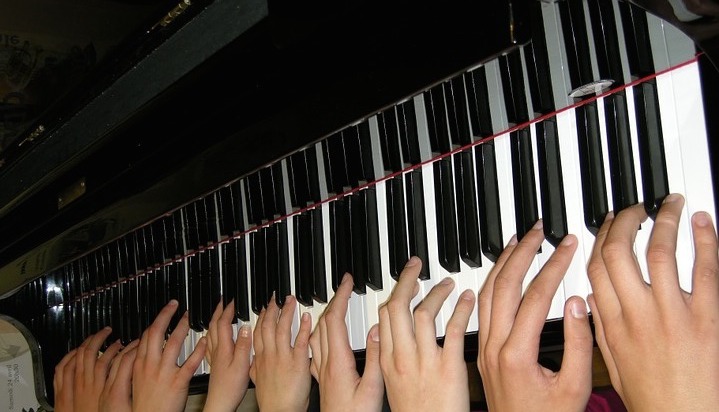
Other factors that contribute to piano-itis are the fact that you have 10 fingers and 88 keys in front of you with the possibility of playing many notes at a time, so it can be easy to overplay, or play notes that you aren’t actually hearing. Many other instruments can only play one note at a time, so they naturally prevent you from doing this. With piano, it’s much easier to play long, “run on sentence” ideas, as opposed to the more , musical, natural, listenable, speech-like phrasing of one note instruments. Usually, horn players can’t keep playing overly long, new ideas while they breathe (unless the can perform circular breathing but that’s another blog post), so they are forced to choose their notes more carefully.
So, the next time you hear a piano player, a guitar player, or perhaps even a circular breathing horn player, playing a solo that’s too long, isn’t very melodic or lyrical, or doesn’t have very musical phrasing, you might find yourself thinking “It sounds like they’ve caught a case of piano-itis”.
Use your ear!
Matt
 It's a Musical Life